
Forklift punctures to 55-gallon steel or poly chemical drums, failing flange gaskets, and cracked tank fittings demand rapid, disciplined action. After reviewing the substance's Safety Data Sheet (SDS) and donning required PPE, EHS responders can stop confusion by deploying SOBLAR's stocked New Pig response gear in a strict four-stage operational sequence.
STEP 01 Step 1: Plugging (Source Mitigation & Pipeline Isolation)
Absorbing liquid on the floor while a drum or tank continues pouring wastes critical time and sorbent inventory. Rotate punctured 55-gallon drums so the hole faces upward to relieve head pressure when safe to do so, then seal cracks or pinholes immediately using spark-free hand-kneadable epoxy putties. When leaked chemicals enter pipe networks or drainage laterals, insert an inflatable pipe plug to isolate downstream flow.

New Pig Epoxy Repair Putty Trio (PTY201 / PTY259 / PTY264)
- PTY201 Universal: Bonds steel, glass, masonry, concrete, and rigid plastics; NSF/ANSI 61 certified.
- PTY259 Underwater / Damp Surface: Specially formulated to cure and bond directly on wet surfaces and underwater breaches.
- PTY264 Steel-Reinforced: Steel-filled putty engineered for high-strength repairs on steel drums, tanks, pumps, and valves; NSF/ANSI 61 certified.
- Shared Performance: 114 g (4 oz) coaxial stick (~18 cm long), 3-5 min working time, ~20 min initial cure, 1-2 hr full cure, Shore D 80 hardness, -29°C to 121°C (149°C peak).
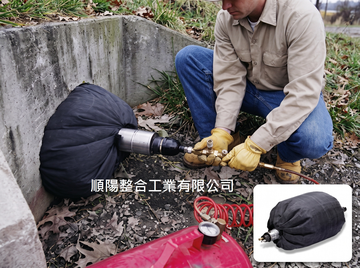
PIG® Multi-Flex™ Inflatable Pipe Plug (PLR111 / PLR112 / PLR113)
- High-Expansion Flex Build: Woven ballistic nylon reinforcement with oil-resistant nitrile rubber expands up to 8x to snake through tight tees and branch taps into larger mainlines.
- Size Coverage:
PLR111fits 9-20 cm (3.5"-8", ~53 cm uninflated length);PLR112fits 14-41 cm (5.5"-16", ~91 cm);PLR113fits 15.5-61 cm (6"-24", ~150 cm). - Field Ratings: Maximum 10 PSI inflation via quick-connect port and 10+ year shelf life. For permanent stormwater outfall control, see PRONAL OPAP permanently installed pipe plugs.
STEP 02 Step 2: Diking & Absorption (Surface Spill Recovery & Acid/Alkali Sorbents)
Once the primary leak is plugged or slowed, contain the chemical pool from the outside perimeter inward. Deploy chemical-resistant absorbent socks to halt spreading across plant aisles, then place high-capacity pillows and meltblown pads over pooled liquid. Concentrated acids and caustics require chemically inert polypropylene HazMat sorbents.

New Pig KIT366 Mobile Chemical Spill Response Drum
- UN-Rated Corrosion-Resistant Overpack: Hinged polyethylene drum keeps chemical sorbents clean, dry, and ready near bulk chemical storage or dock bays.
- Complete HazMat Loadout: Pre-packed with chemical-resistant absorbent socks, pillows, pads, and hazardous waste disposal bags for end-to-end spill control.
- Aggressive Chemical Compatibility: Formulated to safely absorb acids, caustics, and unknown liquid hazards without degrading.

New Pig PIL306 HazMat Chemical Absorbent Pillow
- Compact High Volume: Measures 20 × 20 × 3 cm per pillow, 10 pillows/dispenser box, absorbing up to 8.9 Liters per box (~0.89 L per pillow).
- Inert 100% Polypropylene Fill: Pink HazMat construction safely captures 98% concentrated sulfuric acid and 30% sodium hydroxide without exothermic reaction.
- Scalable HazMat Pairing: Combine with flat MAT302 HazMat chemical pads (83.2 L/bag) or deeper PIL307 extra-capacity pillows (22.5 L/box).
STEP 03 Step 3: Drain Blocking (Preventing Stormwater & Sewer Contamination)
Uncontrolled chemical runoff entering plant storm drains triggers severe environmental liability and emergency shutdowns. Protect nearby trench drains and yard catch basins immediately (concurrently with Step 1 if the leak occurs beside a drain grate) using drive-over sealing mats engineered to survive heavy yard traffic.

PIG® Heavy-Duty Drive-Over DRAINBLOCKER® Drain Cover Mat (PLR30X Series)
- Dual-Layer Seal & Traffic Resistance: Supple polyurethane (PU) bottom molds tightly into rough concrete or asphalt drain aprons while the reinforced top surface withstands repeated loaded forklifts and delivery trucks without tearing.
- Sizing Selection: Available in
PLR300(45 × 45 cm),PLR301(60 × 60 cm),PLR302(90 × 90 cm), andPLR303(105 × 105 cm). Select a mat extending at least 8 to 10 cm beyond all outer edges of the drain grate. - Reusable After Decontamination: Rinse thoroughly with mild soap and water, air dry, and return to storage for subsequent emergencies.
STEP 04 Step 4: Waste Collection (Fire-Safe Staging for Spent Sorbents & Rags)
Once surface chemicals are recovered, rags and wipes saturated with flammable solvents or oxidizing oils pose a dangerous spontaneous combustion hazard if piled in open plastic bins. Transfer oily/solvent-soaked wipes into self-closing safety cans and package spent chemical pads inside heavy-mil hazardous waste bags before manifest disposal.

New Pig CAN139C Hazardous Waste Disposal Can
- Oxygen-Depriving Self-Closing Lid: Hands-free foot pedal opens the lid to a maximum 60-degree angle and snaps shut automatically upon release, starving interior rags of oxygen and blocking external sparks.
- Corrosion-Resistant & Ventilated Construction: Seam-welded galvanized steel body finished with interior and exterior epoxy coating, paired with an elevated ventilated base that dissipates heat to prevent spontaneous ignition.
- Bulk Sorbent Bagging: Package saturated chemical pads and socks inside heavy-duty BAG202 large hazardous waste bags (also available in BAG202 small size).
FAQ Frequently Asked Questions
Q1: For a punctured drum, should you plug the leak or absorb the spill first?
- Plug First (Stop the Source): An unsealed breach will continually overwhelm floor absorbents. Reposition punctured drums with the hole facing up and seal openings with New Pig PTY201 / PTY259 / PTY264 epoxy putty, or insert PLR111 / PLR112 / PLR113 inflatable pipe plugs into leaking lines.
- Absorb Second (Recover Surface Liquid): Roll out the KIT366 mobile chemical spill response kit to dike the spill border, then recover pooled liquid with chemical pads and PIL306 HazMat pillows.
- Block Drains Third (Isolate Outfalls): Seal nearby grates with PLR30X heavy-duty DRAINBLOCKER mats (or deploy concurrently if the leak starts right beside a storm drain).
- Collect Waste Fourth (Prevent Secondary Fires): Stage spent oily/solvent wipes in the CAN139C safety waste can and seal contaminated absorbents inside BAG202 disposal bags.
Q2: Which sorbent mats should be used for acid and alkali chemical spills?
- Concentrated Acids, Strong Caustics & Unknown Liquids (Pink HazMat Polypropylene): Use 100% untreated polypropylene HazMat sorbents such as MAT302 HazMat chemical pads (83.2 L/bag), PIL306 HazMat pillows (8.9 L/box), PIL307 extra-capacity pillows (22.5 L/box), or the hazmat sorbents supplied inside KIT366. They handle 98% sulfuric acid and 30% sodium hydroxide safely without degrading or generating heat.
- Weak Acids/Bases (<50% Concentration) & Coolants (Dark Gray Universal): Among universal sorbents, MAT3001 light-weight universal pads handle oils, water, solvents, and strong acids/alkalis below 50% concentration. Heavy-duty universal pads (MAT3000 and MAT3005) are intended for oils, water, coolants, and standard solvents only—not concentrated acids or caustics.
- Never Use for Aqueous Acids/Alkalis (White Oil-Only): Hydrophobic oil-only sorbents (MAT3002, MAT3003, MAT3004) repel water-based liquids and will not absorb aqueous acid or base spills.
