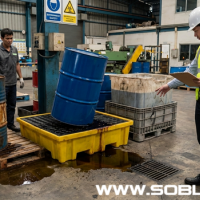
Top 5 Spill Pallet Audit Failures & Corrective Actions for Plant Inspectors - SOBLAR
| Guidance Parameter | Regulatory Criteria & Engineering Solution | Compliance Standard |
|---|---|---|
| Audit Analysis | Field Study of 50+ Taiwan Industrial Plant Environmental Audits | SOBLAR Regulatory Insights #129 |
| Primary Infraction | Open sump drain plug: Invalidates containment, treated as direct spill | Drain plugs must remain closed except during monitored draining |
| Capacity Rule | Sump must hold 100% of largest container OR 10% of total volume | Must account for accumulated rainwater in outdoor yards |
| Corrective Actions | Covered outdoor pallet sheds, routine inspection logs, PE compatibility | Guarantees zero-citation inspection results |
為什麼「有放防漏棧板」仍可能被開改善?
在工廠實務中,防漏棧板通常被視為化學品與油品儲存區的基本防護設備之一。然而在安衛與環保稽查現場,稽查單位關注的不僅是是否設置,更在於是否正確選用、配置與管理。
若防漏棧板使用方式不當,仍可能被認定為洩漏防護不足,進而要求限期改善。
常見錯誤示例一:化學桶直接放置於地面或木棧板上
化學品或油品桶直接放在地面、紙板或木棧板上,無任何集液防護。一旦發生滲漏,液體將迅速擴散,增加地面污染與人員滑倒風險。
稽查重點:
通常被認定為未採取合理洩漏防護措施。
常見錯誤示例二:以非防漏用途容器替代防漏棧板
使用一般塑膠箱、淺盤或自製容器作為防漏設備,實際上無法證明具備足夠的集液容量與結構強度。
稽查重點:
非專用設備難以作為有效二次防護的佐證。
常見錯誤示例三:防漏棧板容量或尺寸不足
防漏棧板集液槽容量過小,無法承接可能洩漏的液體量,或實際使用桶數超過棧板設計規格。
稽查重點:
即使有設置防漏棧板,仍可能被認定防護能力不足。
常見錯誤示例四:防漏棧板內長期積液未清理
防漏棧板內已有液體殘留卻未清理,顯示洩漏未被妥善管理,亦可能造成二次暴露與腐蝕風險。
稽查重點:
常被視為巡檢與管理制度未落實。
常見錯誤示例五:防漏棧板配置位置不當
防漏棧板設置於斜坡、排水孔旁或人員通道上,洩漏時反而提高擴散與接觸風險。
稽查重點:
屬於風險評估與現場配置不當。
環安衛實務建議
防漏棧板的功能不僅在於「有沒有放」,而在於是否放得對、用得對、管得好。
建議工廠安衛人員依化學品性質、儲存量與現場風險評估結果,選擇合適規格之防漏棧板,並納入日常巡檢與管理流程,以降低稽查風險並提升整體環境安全水準。
更進一步的防漏棧板的選購,請電洽 04-22816078 或 來信sales@soblar.com 我們將有專人為您服務。
Need Professional Plant EHS Audit or Technical Consultation?
SOBLAR's senior industrial safety engineers provide on-site plant risk assessments, chemical containment planning, and custom HAZWOPER training across Taiwan. Please contact our advisory team via our Inquiry Board or directly:
📞 Tel: +886-4-2281-6078 | ✉️ Email: service@soblar.com